
🗓️ Published on: June 10, 2026
I Was Building One AI System. Then I Discovered Another Problem Worth Solving
Most technology projects don’t start with code.
They start with conversations.
While working on an AI Revenue Intelligence System focused on healthcare operations, I was introduced to a completely different challenge by someone working in the ABA field.
At first, I assumed the problem was documentation.
But the more I listened, the more I realized documentation was only the visible symptom.
The real issue wasn’t simply documentation.
It was the amount of time and effort surrounding it.
RBTs spending evenings trying to complete session notes.
Supervisors and reviewers spending hours identifying missing information, correcting documentation, and sending notes back for revisions.
Teams working hard to maintain documentation quality while balancing clinical responsibilities, supervision requirements, and day-to-day demands.
The more I learned about ABA workflows, the more I realized this wasn’t just a writing challenge.
It was a documentation and review challenge.
One that directly affects efficiency, consistency, and the amount of administrative work providers carry every day.
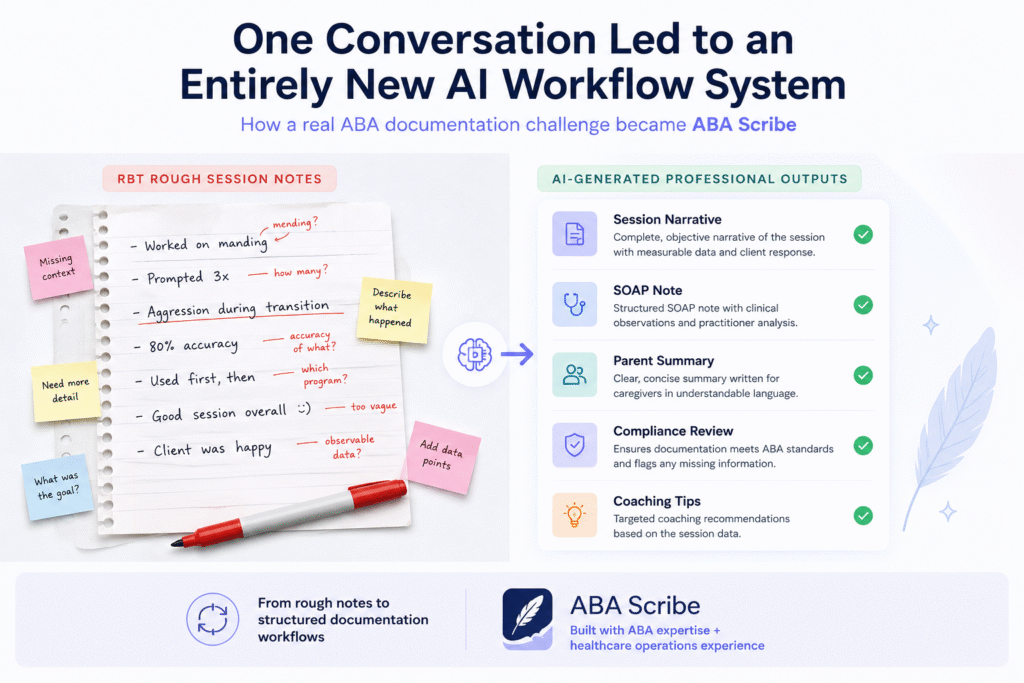
That conversation eventually became what is now ABA Scribe.
Not because I was looking for another product to build.
But because the more I learned, the more I realized the challenge was too significant to ignore.
What started as a conversation eventually became a real platform—one that is now functional, actively being tested, and continuing to evolve.
As someone with a background in healthcare operations, documentation, compliance, and workflow optimization, I immediately recognized a familiar pattern: highly skilled professionals spending valuable time on repetitive administrative processes that could potentially be improved.
Looking Beyond the Documentation Problem
One of the most interesting things I discovered during this process is that documentation isn’t really a single task.
It’s an entire workflow.
A session happens.
Notes are written.
Information is reviewed.
Missing details are identified.
Corrections are made.
Documentation is finalized.
And only then can the process move forward.
The challenge isn’t simply creating a note.
It’s making sure the documentation is complete, consistent, and useful before it reaches the next stage of review.
The more I explored ABA workflows alongside ABA clinical expertise, the more I realized that many of the challenges weren’t unique to ABA at all.
They’re operational challenges.
The same types of workflow bottlenecks, repetitive administrative tasks, review cycles, and documentation dependencies exist throughout healthcare.
Building a Workflow Solution, Not Just a Writing Tool
That realization shaped the direction of ABA Scribe.
Rather than creating another generic AI writing tool, the goal became designing a workflow-focused solution around the way ABA teams actually document, review, and submit their work.
Today, the RBT workflow is functional and actively being tested, with early feedback already showing noticeable improvements in documentation quality.
Development is now expanding into BCBA and supervisor-focused features designed to provide greater visibility into documentation trends, recurring risks, and opportunities for earlier coaching and intervention.
What makes this project particularly interesting to me is that it combines two areas I’ve spent years working with:
- Healthcare operations and workflow optimization
- Real-world clinical documentation challenges
Working alongside ABA clinical expertise has provided invaluable insight into the realities providers face every day, helping ensure the platform is being built around actual workflows rather than assumptions.
What This Experience Has Reinforced
Building both the AI Revenue Intelligence System and ABA Scribe has reinforced the same lesson over and over again:
The biggest opportunities for AI often aren’t about replacing people.
They’re about reducing the repetitive administrative work surrounding the work people actually want to do.
Technology doesn’t solve every problem.
But when designed carefully, it can help reduce friction, improve consistency, and support better workflows.
And sometimes, the best projects aren’t the ones you planned to build.
They’re the ones you discover by listening closely to the problems people face every day.
Final Thought
ABA Scribe is still evolving.
The platform is actively being developed, tested, and refined with direct input from ABA professionals and real-world documentation challenges.
But the journey itself has been a valuable reminder that innovation rarely starts with technology.
It starts with understanding a problem well enough to know it deserves a better solution.
If you’re curious about the project, you can learn more at ABA Scribe.
