
🗓️ Published on: June 10, 2025
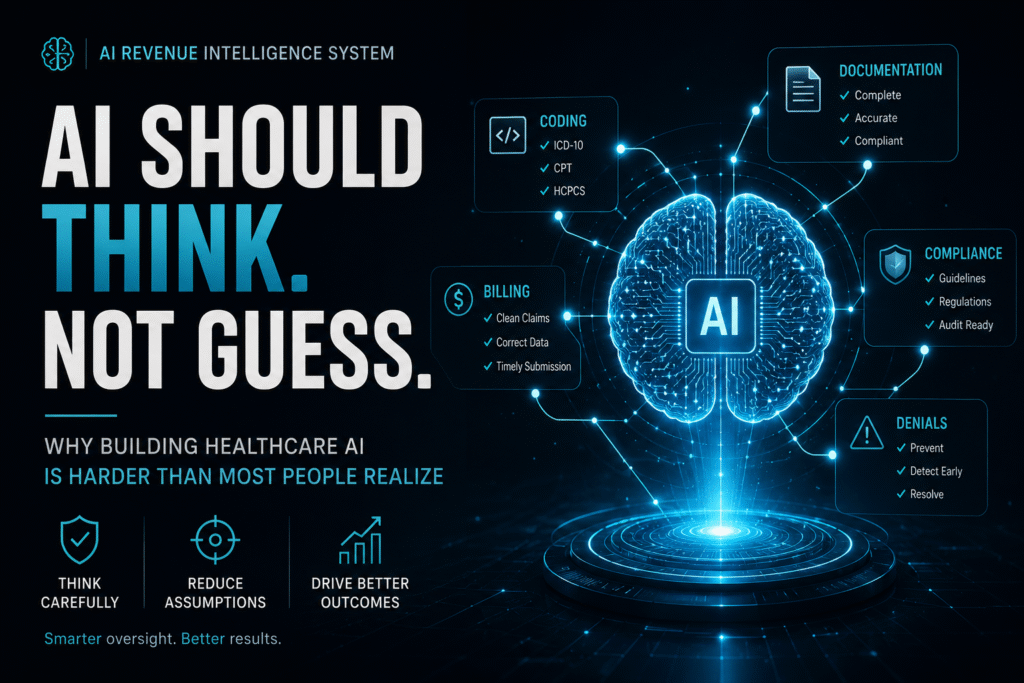
Building AI for Healthcare Is Harder Than Most People Think
Everyone’s talking about AI in healthcare like the biggest challenge is making the technology smarter.
But the more I work on my AI Revenue Intelligence System, the more I realize the real challenge is something else entirely:
👉 Teaching a system how to think carefully without making assumptions.
And in healthcare, that matters more than people realize.
Why Healthcare AI Can’t Just “Guess”
In most industries, an AI tool making a small mistake might create inconvenience.
In healthcare revenue workflows, even a small mistake can quietly lead to:
- Preventable denials
- Missed revenue opportunities
- Documentation conflicts
- Compliance concerns
- Incorrect billing logic
- Delays that affect entire workflows
That’s why building AI for healthcare is very different from building a generic AI assistant.
It’s not just about generating responses.
👉 It’s about creating logic that supports better decision-making while respecting the complexity behind every claim, visit, and workflow.
What I’ve Realized While Building This System
One of the biggest misconceptions about AI in healthcare is the idea that automation alone solves the problem.
But healthcare workflows aren’t simple.
A system can’t just assume something is wrong because a pattern looks unusual.
For example:
- A missing code might actually be appropriate depending on the documentation
- A modifier may be valid for one payer but not another
- Certain visit types require specific workflow logic
- Some gaps require human review instead of automatic conclusions
That means the system has to be designed carefully—not reactive, reckless, or based on assumptions.
👉 It has to be intelligent.
The Goal Isn’t Replacing Human Thinking
This is where I think many conversations about AI miss the point.
The goal shouldn’t be replacing coders, auditors, or healthcare professionals.
The real value comes from helping teams identify potential problems earlier, before they become larger operational or revenue issues.
That’s the philosophy behind the AI Revenue Intelligence System I’m building.
Not a system that blindly automates everything.
But one designed to:
- Detect workflow inconsistencies
- Support coding logic review
- Highlight documentation-dependent risks
- Surface potential denial triggers
- Reduce preventable revenue leakage
- Strengthen oversight before submission
Because prevention is always more efficient than correction.
The More I Build, The More Connected Everything Looks
One thing that has surprised me most during development is how connected healthcare workflows really are.
- Documentation affects coding
- Coding affects billing
- Billing affects denials
- Denials affect revenue
- Revenue affects operations
And many of those issues begin quietly long before anyone notices them.
That’s why I believe the future of healthcare AI isn’t about replacing human expertise.
👉 It’s about creating smarter support systems around it.
Final Thought
Building AI for healthcare has changed the way I see operational problems.
Most of the biggest issues aren’t caused by one major mistake.
They’re usually the result of smaller gaps happening repeatedly across workflows.
And the earlier those gaps can be identified, the more accurate, proactive, and efficient healthcare operations can become.
This system is still evolving.
But one thing has already become clear:
The future of healthcare AI won’t belong to systems that simply generate answers.
It will belong to systems designed to think more carefully, support smarter oversight, and help people make better decisions before problems escalate.
